In Barrera v. Rodriguez-Orengo, decided April 8, 2026, a three-judge panel of Florida’s Fourth District Court of Appeal denied a car crash plaintiff’s motion for a new trial based on juror nondisclosure. The reason: neither side had done the basic work of researching the jury panel’s litigation history before the verdict, despite that information being publicly available online.
What Happened
Miguel Barrera sued Denisse Rodriguez-Orengo and co-defendant Carl Lillquist after a rear-end collision. The defendants conceded negligence, so the only issue at trial was damages. Barrera sought $1 million, citing extensive injuries, three surgeries, future medical expenses, and lost wages. The defense argued his injuries were preexisting and that roughly $36,000 was appropriate. The jury awarded $20,000, limited to past medical expenses and past lost wages.
After the verdict, Barrera moved for a new trial. His argument: the jury foreperson had disclosed only one prior legal matter during voir dire, when in reality she had been involved in seven lawsuits and an appeal in the Fourth District. In one of those cases, she had described the legal system as “slow, costly, and ultimately hopeless.”
The Investigative Gap
The court was not persuaded. Under Florida’s De La Rosa test for juror nondisclosure, a party must demonstrate relevance, concealment, and diligence. It was the diligence element that failed here.
The foreperson had voluntarily mentioned involvement in a “very large case” involving construction work on her home and a subsequent foreclosure. That partial disclosure, the court held, put the parties on notice to investigate further. As the panel put it, “It became incumbent on the parties to inquire further if they wanted to know more about her litigation history.” Neither side did so.
The court pointed to the fact that every county in Florida maintains official public records and court files online. The foreperson’s full litigation history was there to be found. No one looked.
Where This May Be Heading
The court included a footnote that goes beyond this case. The panel observed that juror nondisclosure disputes may be generating unnecessary work for litigants and courts, as well as unnecessary retrials, “to the detriment of the entire judicial system.”
The panel then suggested that the Florida Supreme Court may want to revisit the diligence standard entirely, specifically whether counsel should be required to investigate and raise juror disclosure issues before the jury is dismissed in order to preserve such a challenge. If that standard is adopted, the timeline for identifying and acting on nondisclosure narrows considerably, and thorough pre-verdict juror research becomes even more critical.
JurorSMARTS
This is the kind of gap Smith & Carson’s JurorSMARTS platform is built to close. JurorSMARTS combines a dedicated jury research team with specialized technology to investigate individual juror backgrounds, identify viewpoints and undisclosed biases, and monitor web and social media activity by seated jurors throughout the proceeding. Beyond research, the platform gives attorneys tools to manage the selection process itself: rating and annotating individual jurors, tracking their status through challenges and strikes, and maintaining a structured record of the panel as it takes shape. JurorSMARTS also provides data analysis on jury pools that highlights jurisdictional traits and trends, helping refine selection strategy across cases.
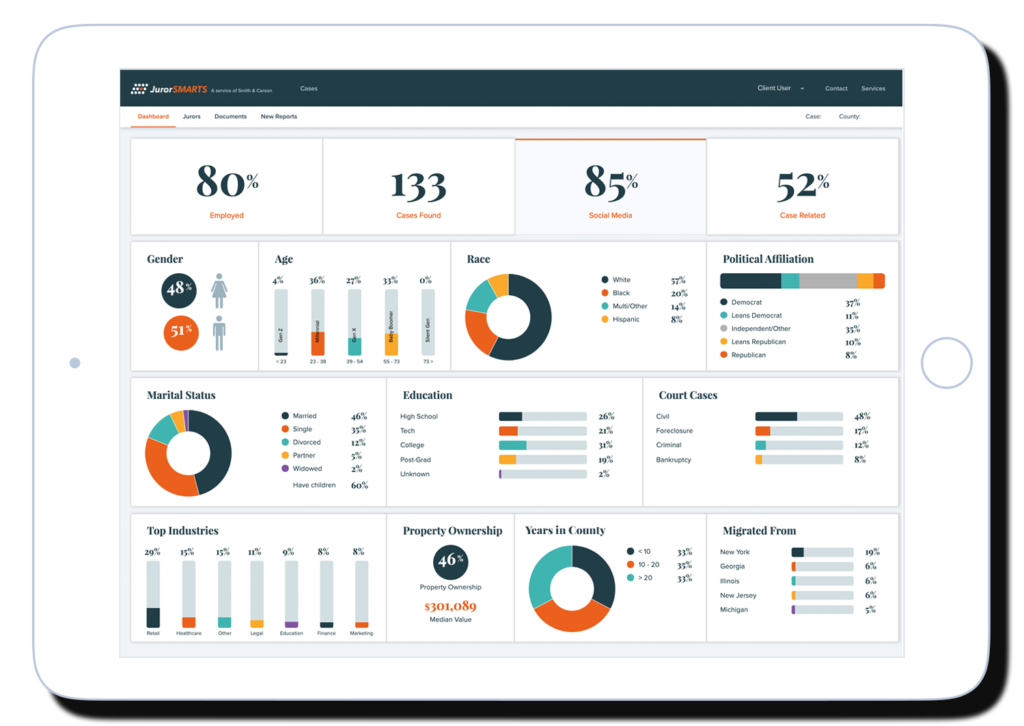
In Barrera, the type of information our juror research team is trained to surface was sitting in public records. Whether it went undiscovered or simply unreviewed, the result was the same. Our juror research pairs an experienced team of researchers with custom technology to ensure that kind of gap doesn’t reach the courtroom.
The case is Barrera v. Rodriguez-Orengo et al., No. 4D2024-2661, in the Fourth District Court of Appeal of the State of Florida.
Kang, Y. Peter. “Juror Nondisclosure Can’t Trigger Crash Retrial, Panel Says.” Law360, April 8, 2026.